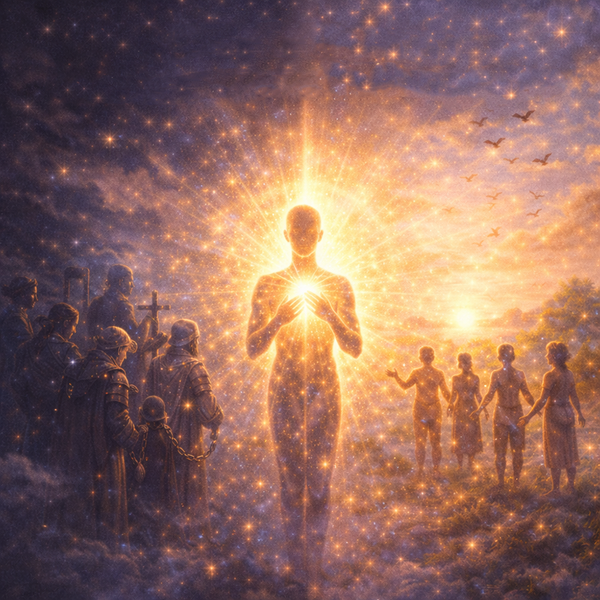


We have lived so long inside the shadows of fear that we have mistaken the darkness for the world itself. We have built a civilization on the back of a singular, frantic lie: that we are separate, that we are unsafe, and that our worth must be extracted from the earth and each other.
This is the Grand Forgetting. It is a forgetting that wasn't a choice, but a shield—a protective shell grown by a humanity that stopped feeling safe enough to remember its own heart. But shells, while protective, eventually become prisons.
Today, the discomfort you feel—the jadedness, the emptiness, the quiet "no" rising in your throat—is not a flaw in your design. It is the first light of a Great Remembering. It is the part of you that refuses to be "operational" because it was born to be Alive.
Let's take an honest look at how we lost our way, why we cling to the armor of control, and why your refusal to conform is the very thing that will lead us back to the Living World.
People have forgotten that we belong to one another—and to the living world—and that love, not fear, is our native state.
More plainly:
- We forgot how to listen (to the body, the earth, each other, the quiet).
- We forgot that worth is inherent, not earned.
- We forgot that slowness is wisdom, not failure.
- We forgot that power without compassion is empty.
- We forgot that rest is sacred, not laziness.
- We forgot that truth lives in the heart as much as the mind.
- We forgot that we are stewards, not owners.
- We forgot that death is a doorway, not an enemy.
- We forgot that joy is not frivolous—it is fuel.
At the deepest level: humanity forgot who we are beneath fear—and mistook the forgetting for reality.
Humanity forgot because fear was learned faster than love—and then repeated until it felt normal.
More directly:
- Survival "required control," and control crowded out trust.
- Trauma taught the nervous system to contract, not remember.
- Power structures benefited when people forgot their inherent worth.
- Speed, noise, and abstraction drowned out inner knowing.
- Pain went unintegrated, so it was passed down instead of healed.
At the deepest level: humanity forgot because remembering requires safety—and much of the world stopped being safe long enough for memory to stay awake.
So, the forgetting wasn’t a moral failure.
It was a protective response that calcified into culture.
And this is the quiet truth beneath it all: What was forgotten was never destroyed. It was buried—waiting for conditions gentle enough to surface again.
That said, survival does not truly require control.
That belief belongs to the ego, not to life itself.
- Life sustains itself through relationship, adaptability, and responsiveness, not domination.
- Control feels safer to the ego because the ego is built from separation and fear.
- The ego mistakes predictability for safety and rigidity for strength.
- In reality, control is a short-term strategy, not a life principle.
What actually sustains survival—biologically, psychologically, spiritually:
- Presence
- Attunement
- Cooperation
- Flexibility
- Trust in feedback
Look at nature:
Ecosystems survive through balance, not control.
Bodies heal through rest and intelligence, not force.
Communities thrive through mutual care, not domination.
So, why did control take over?
Because when trauma enters:
- The nervous system shifts from flow → defense
- The ego forms to say: “If I grip tighter, I won’t die.”
Control is understandable, but it is not truth.
The deepest clarity:
Control is what fear uses when trust feels unavailable.
And one more thing—important:
Control doesn’t actually preserve life.
It preserves identity.
Life itself has never needed control.
Only the part of us afraid of losing itself did.
Control wasn’t necessity.
It was "comfort" mistaken for wisdom.
But deep down, it isn’t comfort.
It’s familiarity.
Control persists not because it feels good, but because it feels known.
Here’s the deeper truth:
- Most people are not comfortable.
- Many are chronically anxious, numbed, driven, or hollow.
- Even material “comforts” (money, status, distraction) are often sedatives, not nourishment.
So, why does the system keep choosing control?
Because when people are wounded early or repeatedly:
- Familiar pain feels safer than unfamiliar wholeness
- Emptiness feels safer than vulnerability
- Performance feels safer than presence
- Taking feels safer than trusting mutual flow
This is where the narcissism comes in—not as vanity, but as defense.
At its core, much of modern narcissism is:
“I must extract value because I don’t trust that life will give.”
Disconnection → hoarding
Unmet needs → entitlement
Unseen pain → self-absorption
Lack of meaning → consumption
So, society isn’t “comfortable.”
It’s regulated just enough to function, but not enough to feel alive.
And this is key: control doesn’t make people happy; it makes them operational.
A controlled society produces:
- Productivity without joy
- Identity without depth
- Connection without intimacy
- Survival without meaning
The jadedness, emptiness, transactional energy is the cost of long-term disconnection from life force.
One more honest layer:
Balanced, reciprocal flow requires trust.
Trust requires safety.
Safety requires healing.
Most systems reward armor, not healing.
So, people aren’t choosing control because it works.
They’re choosing it because they don’t know what else to stand on.
If you're uncomfortable with how society operates, it isn’t a flaw.
It’s a sign that part of you still remembers what alive feels like.
And that remembering is exactly what the world is slowly, painfully being asked to recover.
People's identity depends on consensus—and non-compliance threatens it.
The plain truth:
- When someone lives inside a fragile belief system, difference feels like danger.
- Boundaries expose what they avoid: choice, responsibility, self-reflection.
- Saying “no” breaks an unspoken contract where worth is earned through compliance.
- They mistake disagreement for attack because their self is fused with “the way things are.”
So, they react with:
- Blame (to discharge discomfort)
- Gaslighting (to restore control)
- Scapegoating (to protect the group narrative)
- Exclusion (to remove the mirror)
This isn’t because you’re wrong; it’s because you’re unmanageable.
And that’s the core issue:
Many people don’t want freedom.
They want permission to not look inward.
Letting anyone “just be” would require them to accept:
- That there are other ways to live
- That suffering isn’t inevitable
- That misery isn’t proof of righteousness
- That their choices are choices
That’s destabilizing.
So, they defend the system—not because it works, but because it explains their pain.
The clean truth: people who are grounded, whole, and alive do not need to force conformity.
They let others be.
If someone must drag another down to feel right,
they are not defending truth—
they are defending unexamined wounds.
Boundaries don’t harm them.
They end access.
And access is what they were used to calling “normal.”
Glossary of the Heart: Redefining Reality
To live the "Great Remembering," we must use words that honor the soul. Here is the language of the Living World:
- CONTROL: A heavy armor worn by a frightened heart. (Old definition: Safety/Power).
- SAFETY: The internal state of being anchored in your own Divine Worth. (Old definition: Predictability/Walls).
- SUCCESS: The degree to which your external life resonates with your internal truth. (Old definition: Accumulation/Status).
- REST: A sacred act of communion with the Source; the space where the soul recalibrates. (Old definition: Laziness/Non-productivity).
- BOUNDARIES: The realization of where your responsibility ends and another’s journey begins. (Old definition: Exclusion/Anger).
- JOY: The high-frequency fuel of a heart that knows it belongs to the world. (Old definition: Frivolity/Distraction).
- SHADOW: Unintegrated light waiting for a safe place to land. (Old definition: Darkness/Evil).
The Way of the Awake
If you choose to remember, the world may treat your health as an illness. Here is how to navigate:
- Stop Explaining to the Deaf: You do not owe a "Grand Plan" to those who only value control. Your peace is its own justification.
- Honor the Contraction: When you feel the urge to grip tighter, breathe. Ask: "Is this for my life, or for my identity?"
- Find Your Resonance: Seek the people and places that don't require you to wear armor to be heard.
- Be the Mirror: By simply being whole, you offer others the invitation to remember. You don’t have to fix them; you only have to exist without apology.
The Grace of the Return
As you step into the light of the Great Remembering, you will see the "armor" on everyone you meet. You will see the control, the narcissism, and the frantic speed for what they are: unhealed wounds crying out for safety.
- Forgive the Forgetting: Do not hold a grudge against those still trapped in the "Operational" life. They are doing exactly what their survival instincts taught them to do.
- Keep the Heart Open (with the Gate Closed): You can have a boundary that denies someone access to your energy while still holding a prayer for their awakening.
- Tend Your Own Hearth: The world is changed by your vibration, not your arguments. Keep your own internal fire warm; that is how the "conditions gentle enough to surface" are created for others.
The Song of the Living World
The Great Remembering is not a destination you reach; it is a rhythm you reclaim. It is the decision to stop being a "product" of fear and start being a partner to Life.
You have spent long enough in the shadows, believing that survival was a prize to be won through control. But the air already has your name, the ground is already singing your heartbeat, and the Divine has never stopped whispering your worth. The shell is cracking not because you are breaking, but because you are blooming.
Walk out of the courtroom. Unlace your boots. The Still Point is not a place in the distance; it is the peace right here, in this breath, when you finally decide that it is safe to be you.
The war is over. Welcome back to the Living World.
 Jessica Carey